Converting the Masses into Brutal Death Metal Stans with Lille Gruber
I love brutal death metal. For those uninitiated: It’s a genre of extremity and shock undergirded by insurmountable technicality and musicianship. More formally, brutal death metal (BDM) is a branch of the death metal subgenre that prioritizes heaviness, speed, and complexity above all else. It’s characterized by the use of gutturals (aka death growls but nobody calls them that), pig squeals, extremely down-tuned guitars, heavily discordant riffs (usually on the diminished scale, twelve-tone, or sometimes even whole!) structured by drum sections of “groove” or “blast”: moderate-tempo in-the-pocket sections and ultra-high-tempo sections.
Unfortunately, not too many people like brutal death metal as much as I do. My radio show is all about pulling people from where their music taste currently stands into the fiery depths of extreme metal. It is extremely difficult to do this, though. Extreme music has seen success among Gen Z with bands like Sanguisugabogg. Many fans of the newer breed of death metal sound, hardcore culture bands like Sanguisugabogg would be prime targets for conversion into the cult of brutal death metal! So, to aid my quest, I interviewed one of extreme metal’s patron saints (in my opinion): Lille Gruber, the main man of Defeated Sanity, who opened for Sanguisugabogg this fall. Here’s what we had to talk about:
What would you say to someone who’s currently into hardcore, but wants to know all about what brutal death metal is about?
Lille: First of all, I think hardcore and metal have always influenced each other, and it’s no exception for us. While our main prerogative is death metal, we’ve always been inspired by other kinds of music, and the groove…everybody that comes to a Defeated Sanity show will experience those groove bits and see something familiar. Metal just goes more extreme. You’ve got to be built for it. Some people don’t want to listen to that, turn on their brain, and just want something to move to. But the people that can deal with it will be drawn to it anyway. This is definitely an opportunity to catch them.
What’s your take on hardcore-style crowd killing at your shows? Have you seen anything crazy?
Lille: Nothing really annoying so far. I’ve learned that that stuff is more like a game. Some people misunderstand it or get disturbed by it, but it’s like wrestling - it’s not real. Problems start when people think it’s real. I’ve been part of the hardcore scene, too. Back then it was a more homogenic crowd, and the big game was fighting for the microphone. Now there’s always a hole in the middle, the kung-fu pit...it makes stage diving harder. People jump and land on the ground right away. Back when I went to hardcore shows, you jumped and someone would catch you. Now they make this circle and it’s counterproductive.
Defeated Sanity is very physical, embodied music. Where do you try to steer the ship in terms of groove versus technicality?
Lille: We’ve always been inspired by traditional bands when they went progressive. Even Slayer has cool licks. Suffocation, too. For us, Disgorge - Consume the Forsaken - was very progressive. It’s brutal death metal, but if you zoom in it’s very artistic. Zoomed out it’s grimy death metal but zoom in and you see the asymmetries.
Your writing feels very organic - improvised, almost - but still structured. How does that come about?
Lille: It takes a long time. Songs sit for months. You get ideas walking around. It grows over time. You’re not sitting down saying, “I’m going to write a five over seven.” Sometimes it’s a tool, but it’s just part of the language.
Shifting gears now. What kind of artistic meaning or vision did you try to infuse in the last album?
Lille: It’s about the human psyche and what can go wrong - neurological disorders, trauma, diseases. It’s scientific and philosophical, but not artsy-fartsy. It fits death metal.
A lot of OG bands like Cryptopsy have been shifting to a more melodic style, and it seems like the currents of the genre are moving more in that direction. Do you feel any pressure to make something more melodic?
Lille: Absolutely not. Melody is cool, but it depends. Death’s Human was melodic in a good way. After that it got too sweet. We would never go there. Our melodies are more like modern classical - some people call it atonal. In fact, since the second album, there’s a twelve-tone row on every album. Twelve-tone is kinda old, it started with classical music, but it still works.
What about a push to feel more polished? To have a super clean locked-in metallic feel like some modern tech-death bands?
Lille: We chose our sound because it feels live. Triggers take away energy for me. The more human it sounds, the more you can take in that real people are doing it. Morrisound productions were the best balance.
Looking at the large scale of death metal, what trends have you seen over time? What do you think is going on right now? What words of wisdom have ye?
Lillith: Raw production doesn’t make a band great. Great songs do. I don’t care about trends. I care about content. I grew up with straight-edge hardcore. In every song we play there’s a groove inspired by Earth Crisis or Turmoil.
Now, one last thing...Mount Rushmore of brutal death metal, go!
Lillith: Devourment, Disgorge, Gorgasm, Brodequin, Regurgitation. Albums like Consume the Forsaken, Tomb of the Mutilated, Forensic. My ideal thing is a connection of body, soul, heart, and intellect.
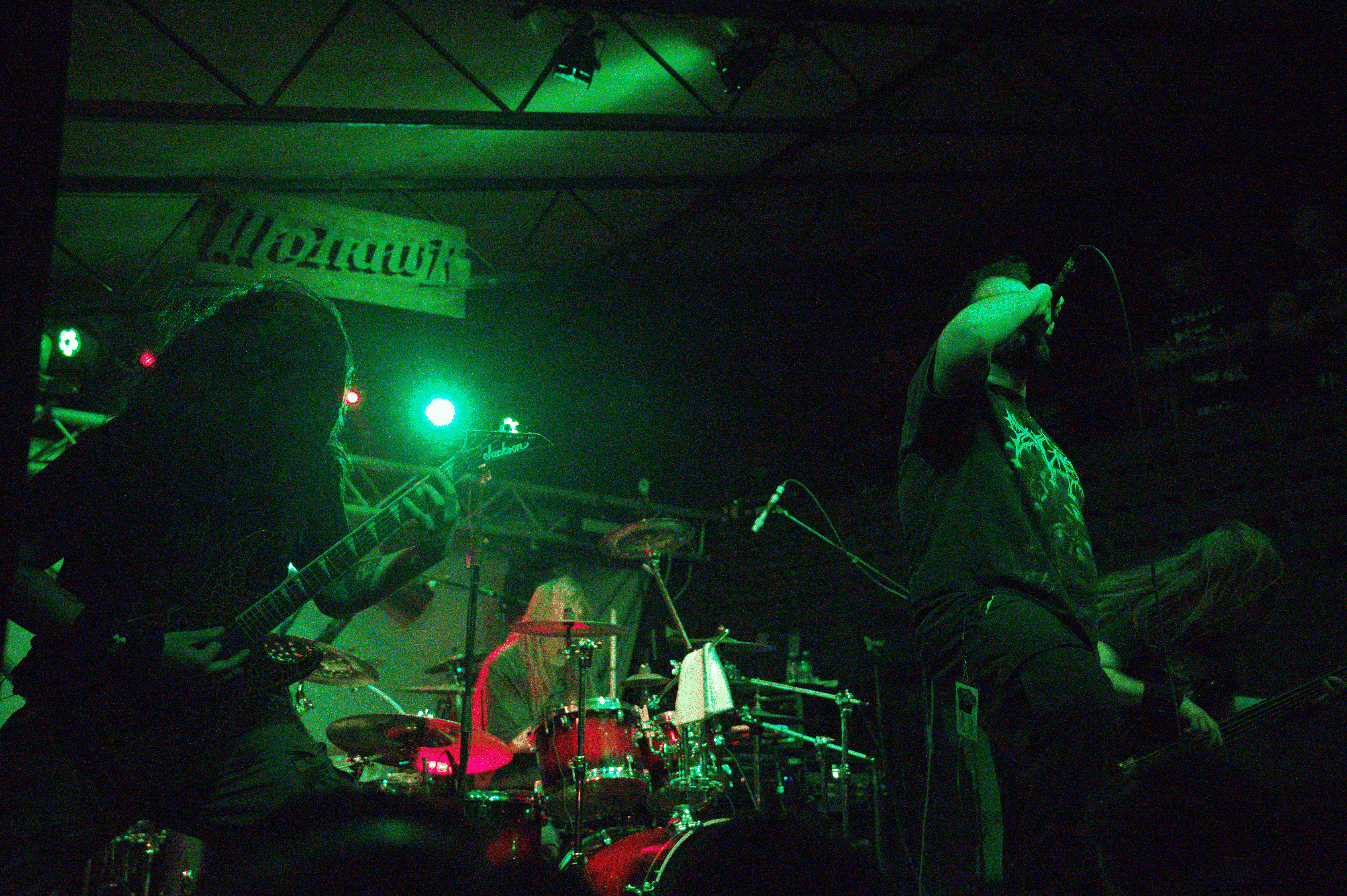
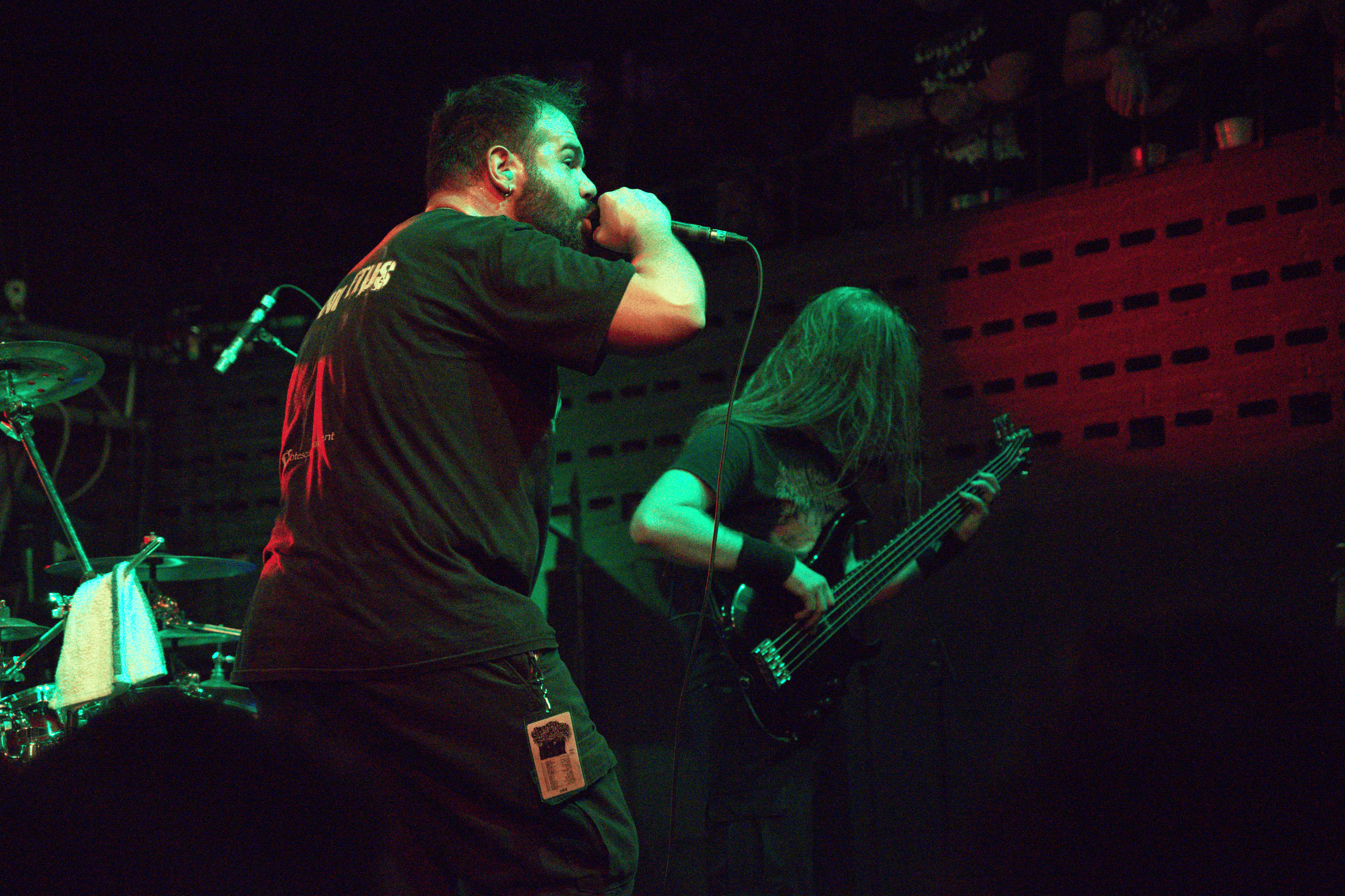
Now, on to the show. Defeated Sanity is tight live. I’ve seen Dream Theater three times, Opeth twice, and a myriad of brainy tech death bands to boot. Still, Defeated Sanity might be the most unimaginably locked in band I’ve ever seen. Everything, every groove, every slam riff, had a physical impact. Every time the band recollected after a period of jamming or disconnected syncopation and locked into a single 4/4 groove, a shockwave was sent out. This shockwave was sonic - from the sheer volume of the combined instrumentation - and it was physical - from motion induced in the audience. The drums are at times relentless - blasts all the way - and at other times locked into an esoteric groove. The guitars and bass similarly oscillate between two personalities: braindead “caveman” riffing, as Lille would say, and cerebral, technical “stop-start” twelve-tone dissonant riffing. The vocals, like in most death metal, were that characteristic “texture-giver” to all this interplay.
The result of the live sound of Defeated Sanity, despite what might be misconstrued as something elitist and cerebral, was something fundamentally primal and physical. The music spins something up deep inside you that makes you want to move. It makes you want to move in a very specific way. It doesn’t make you want boogie, waltz, or two-step; it makes you want to get violent. When the band periodically returned, collected themselves into that straight 4/4 groove, slammed like they’ve never slammed, and sent out that shockwave, it made you want to freak out, move, get physical, get violent. It made you want to move in a way that could only be relieved through violence. Musical statements are made more effective through contrast. Loudness made “louder” through softness. In the case of Defeated Sanity, the primality of the slam groove is amplified tenfold by its contrast with stank-face, polyrhythmic, syncopated sections, and it’s unlike anything else I’ve experienced live.
More Like This
MORE FREQUENCY